...says he wants elections where loser will congratulate winner’
…..denies ever Represented Tinubu At 2023 Presidential Election Petitions Court
… vows to audit IReV, make INEC truly independent
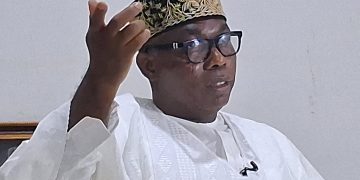
The Senate has confirmed Joash Amupitan as the new Chairman of the Independent National Electoral Commission (INEC).
Amupitan, a professor of Law, was confirmed by the upper chamber after his screening on Thursday.
His confirmation came after over two hours of questioning by senators, who pressed him on how he plans to restore credibility to Nigeria’s electoral process and implement meaningful reforms within the commission.
The 58-year-old don was nominated by President Bola Tinubu and received formal endorsement from the National Council of State last week.
Amupitan becomes the sixth substantive Chairman of INEC, succeeding Mahmood Yakubu, who has officially concluded his tenure as the INEC boss.
Electoral Reforms
The Chairman-designate pushed for electoral reforms, saying that Nigeria deserves elections where the loser will congratulate the winner.
Amupitan said he would examine the Electoral Act to strengthen the credibility of Nigerian elections.
According to him, there are inconsistencies in the timeline of elections in Nigeria, a situation he says can be improved.
He stated that credible elections would restore voters’ confidence.
“So, we’re going to see how an election is credible, so that the loser will come and congratulate the winner and say, ‘You won fairly and well’.
“So if we can do that, it’s just like a judge convicting a person, sentencing him to death, and he (convict) says, ‘Well done, because I believe I’ve gotten justice,’” the professor said.
‘Not Tinubu’s Counsel’
The professor also denied the speculation that he was part of the legal team that represented President Bola Tinubu at the 2023 Presidential Election Petitions Court (PEPC).
“You also talked about whether I was part of the presidential election team. I have also read it.
“It is very simple to answer. The Law reports on those cases have been out. And even when I was coming, I decided to have certified true copies of the counsel that appeared.
“I never, I did not appear in the presidential election tribunal and at the Supreme Court,” the 58-year-old Law professor said while responding to a question from the lawmaker represent Bayelsa West, Senator Seriake Dickson.
He also denied representing Peter Obi of the Labour Party or the Peoples Democratic Party (PDP) at the tribunal.
“I was not part of it,” he stated when Senate President Godswil Akpabio asked him whether he was part of the legal teams of the opposition.
Amupitan: I’ll audit IReV, make INEC independent
Chairman of the Independent National Electoral Commission (INEC), Prof. Joash Amupitan (SAN), has pledged to conduct a comprehensive audit of the commission’s Results Viewing Portal (IReV) to identify and address the technical issues that undermined public confidence during the 2023 general elections.
Speaking when he appeared before the Senate for screening, on Thursday, Amupitan said the audit would help determine the nature of the glitches that affected the real-time transmission of results, as well as assess the current capacity of INEC’s electoral technology systems.
“I have to audit the system, if I’m given the opportunity, to see what is actually wrong and whether we have what it takes as it is now,” Amupitan said.
He explained that the IReV portal, along with the Bimodal Voter Accreditation System (BVAS), was introduced to enhance the transparency and integrity of elections, noting that technical challenges experienced during the 2023 polls raised concerns about the system’s effectiveness.
Amupitan noted that while the IReV was designed as a safeguard for comparison and verification, it was never intended to replace manual collation of results.
He added that inadequate communication of this distinction contributed to the misunderstanding that trailed the use of the portal during the elections.
“The Supreme Court has clarified that IReV is not an electronic collation system. However, it was meant to provide checks and balances to enhance credibility. Unfortunately, this was not properly explained before the election,” he said.
Amupitan vowed that trust and ethical conduct would be the cornerstone of his leadership.
“I think that trust is a major concern. We will work out an internal mechanism to try the behaviour of humans. I’m taking this position on trust, and my people must also appreciate that they hold their positions on trust. We will set up an ethical committee to review what has happened in the past because complaints have been made, yet no action has been taken. We will pursue every complaint and follow through,” he added.
He also stressed the need for collaboration among relevant agencies — including the Nigerian Communications Commission (NCC), National Identity Management Commission (NIMC), and service providers — to improve the reliability of election technologies.
“It is not just INEC’s responsibility. Other institutions that support the process must also work together to ensure that Nigerians can trust the technology we deploy,” he added.
Beyond technology reforms, Amupitan assured lawmakers that he would take steps to strengthen INEC’s institutional independence in line with constitutional provisions.
He acknowledged that the commission’s autonomy has often been limited by delayed release of funds and a lack of clarity regarding its constitutional powers.
“Although the law provides that funds should be released a year before elections, in practice, this has not always been done on time. This creates financial constraints for the commission,” he said.
Amupitan promised to review existing laws and administrative frameworks to identify and address factors affecting INEC’s independence.
“We will look at the spirit and letter of the Constitution, as well as the laws made by the National Assembly, to ensure that INEC truly operates as an independent body. We shall audit the system and deal with any challenges accordingly,” he said.