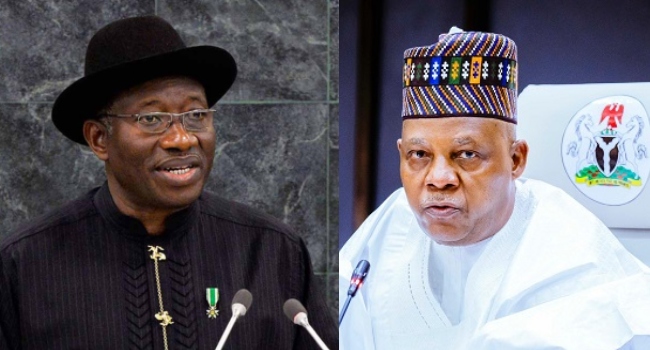
Vice President Kashim Shettima has said he was the “most demonised” person under the administration of former President Goodluck Jonathan.
He said the then president mooted the idea of removing him as Borno State governor but the then Attorney General of the Federation, Mohammed Adoke, stopped the idea.
Shettima spoke on Thursday in Abuja at the public presentation of Adoke’s memoir. The book has its title as ‘OPL 245: Inside Story of the $1.3 billion Nigerian oil block’.
The former Borno governor said Adoke was brave enough to tell Jonathan that he had no constitutional power to remove even an elected councillor let alone an elected governor.
Shettima was governor of the insurgent-ridden northeast state from May 2011 to May 2019.
At the peak of the insurgency, on December 31, 2011, Jonathan declared a state of emergency in some local governments in Borno and Plateau states.
Some 18 months later, on May 14, 2013, Jonathan declared a state of emergency for the entire terrorist-plagued states of Borno, Yobe and Adamawa but he did not suspend any of the governors.
Ironically, on March 18, 2025, Shettima’s principal, President Bola Tinubu, declared a state of emergency in Rivers State amid a protracted political crisis in the state, and suspended Governor Siminalayi Fubara; his deputy Ngozi Odu; as well as all the members of the House of Assembly for six months.
Tinubu immediately appointed ex-naval chief Vice Admiral Ibokette Ibas as administrator to take charge of the affairs of the oil-rich Niger Delta state, a decision that has been flayed by many leaders of thought.
Conversely, the current AGF Lateef Fagbemi, unlike Adoke, justified the suspension of Fubara, his deputy and members of the state’s legislature.
Watch the video:
Meanwhile, former Attorney-General of the Federation and Minister of Justice, Mohammed Bello Adoke, has stated that he has forgiven all who played a role in what he describes as a long and painful ordeal involving his prosecution over the controversial OPL 245.
Adoke spoke on Thursday in Abuja during the public unveiling of his memoir “OPL245: Inside Story of the $1.3 Billion Nigerian Oil Block”. The book offers his personal account of the events surrounding the 2011 oil block transaction involving Shell and Eni, which led to years of legal battles and public scrutiny.
The OPL 245 saga remains one of the most controversial oil deals in Nigeria’s history. At the heart of the case was the transfer of a lucrative oil block, OPL 245, from Malabu Oil and Gas to Shell and Eni, a deal allegedly marred by irregularities.
Adoke, who served as AGF during the Goodluck Jonathan administration and was central to the implementation of the oil block agreement, was prosecuted by the Economic and Financial Crimes Commission (EFCC) on an amended 40-count charge bordering on disobeying direction of the law, offering and receiving gratification, conspiracy and forgery, among others.
He, along with six other co-defendants, was, however, discharged and acquitted in 2024 by an FCT High Court.
While the former AGF had consistently argued that his involvement in the Malabu deal was guided by legal advice and a desire to resolve a longstanding dispute, addressing years of allegations, investigations, and legal battles tied to the controversial OPL 245 oil block deal, Adoke expressed his conviction that his actions were both lawful and in service of the country.
“I did not set out to denigrate anyone. This book is my attempt to set the record straight and provide insight into a transaction carried out to protect Nigeria’s economic interest in hydrocarbon exploitation. I suffered immense public odium, a damaged reputation, and a shattered family life”, he recalled.
Adoke accused the Economic and Financial Crimes Commission (EFCC) of misconduct, saying their investigators suppressed evidence and coerced witnesses to secure a conviction against him.
Yet despite his criticisms, Adoke emphasised healing over hostility. “Permit me to say that I have forgiven all those who had a hand in my ordeal”, he stated.
The former AGF acknowledged Ibrahim Magu, former acting EFCC chairman, for extending an apology and expressing remorse.
“I admired the courage of Ibrahim Mustapha Magu in coming forward to make up with me. I have forgiven him”, he said.