Despite being home to some of the world’s largest oil and gas reserves, Nigeria and Africa at large remain caught in energy import dependency, spending over $120 billion on the importation of refined petroleum products and other hydrocarbon-related services.
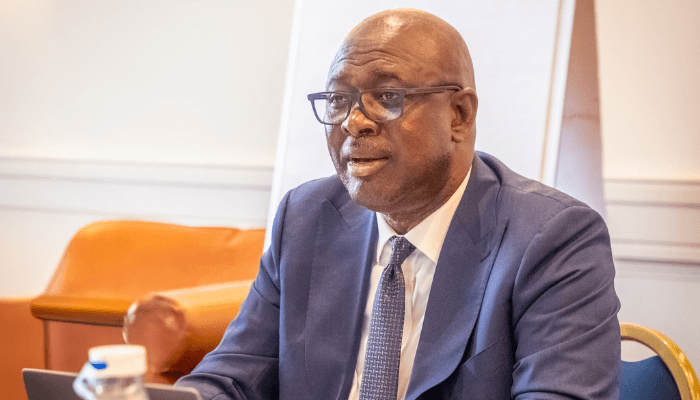
Heineken Lokpobiri, Nigeria’s minister of petroleum resources (oil) disclosed this at the ongoing Nigerian International Energy Summit (NIES) in Abuja on Tuesday.
According to the minister, this level of expenditure, which was primarily on the importation of refined petroleum products and other hydrocarbon-related services, represents not just a financial cost, but a lost opportunity for economic transformation.
He maintained that if Africa can retain a proportion of that spending within the continent through localized value addition, infrastructure development, and industrial participation, the economic impact would be transformative.
He said, “Africa currently spends over $120 billion annually on hydrocarbons alone, a staggering outflow of capital. This level of expenditure, primarily on the importation of refined petroleum products and other hydrocarbon-related services, represents not just a financial cost, but a lost opportunity for economic transformation.
“That is why we should support the African Energy Bank (AEB) with its headquarters in Nigeria. If we do not mobilize the appropriate resources to solve our energy problems in Africa our misery will increase as our population grows, the responsibility is ours and ours alone.
“As host country we have fulfilled our obligations, the ball is in the court of the promoters to set the ball rolling.
Ultimately, this shift is not merely about energy self-sufficiency, it is about economic sovereignty, industrialization, and inclusive growth.”
Lokpobiri further explained that retaining hydrocarbon value in Africa means creating the fiscal space and investment capacity needed to power critical sectors such as healthcare, education, infrastructure, security and technology.
He stressed that governments must focus on addressing the energy trilemma of availability, accessibility and affordability of all forms of energy. “No country in the world is abandoning oil and gas, and you can be rest assured that Nigeria will not either.
“This is more so in the face of new realities that we find in reports, such as the International Energy Agency (IEA) world outlook 2025, OPEC world outlook 2025 and several other reports on global energy which shows that the world is moving from conversations around transition to conversation around energy mix. Both reports posit that in the foreseeable future, fossil fuels will be the dominant energy source globally,” Lokpobiri added.
In his remarks, Farid Ghezali, Secretary General of the African Petroleum Producers’ Organization (APPO) stated that for Africa, which is rich in energy resources, the challenge is not only to extract but to transform these resources into real share worth for its population.
He decried that despite the immense potential, Africa is facing a paradoxical and frustrating reality of exporting about 70 percent of its crude oil and 45 percent of natural gas, thereby losing $15 billion per year.
This, he said is an added value that could be generated locally, especially in the midstream and downstream segments.
“Financing remains the main bottleneck hindering the development of our strategic projects. More than 150 essential projects, from refineries to pipelines, such as the AKK pipeline, to gas infrastructure remain blocked because the cost of financing in Africa is 15-20 percent compared to only 4-6 percent in Asia.
“This disparity is unacceptable and slows down our progress. In addition, the fragmentation of our energy financial ecosystem is a challenge. Our 18 national oil companies’ in APPO often operate in isolation, without a common stock exchange, which severely limits regional synergies and our collective ability to attract massive capital,” he said.
Faced with this emergency, he said APPO has forgedva resilient African and pragmatic solution, through the African Energy Bank which is scheduled to launch in the first half of 2026.
” The bank is much more than just a financial institution. It is a pan-African platform for the exchange of equipment, energy services and, above all, a catalyst for innovative financing to support structuring African energy projects.
“Because I think it’s time to produce what we are consuming and to consume what we are producing. The African Energy Bank is designed to unlock the 200 billion needed for our midstream-downstream project by 2030,” he said.