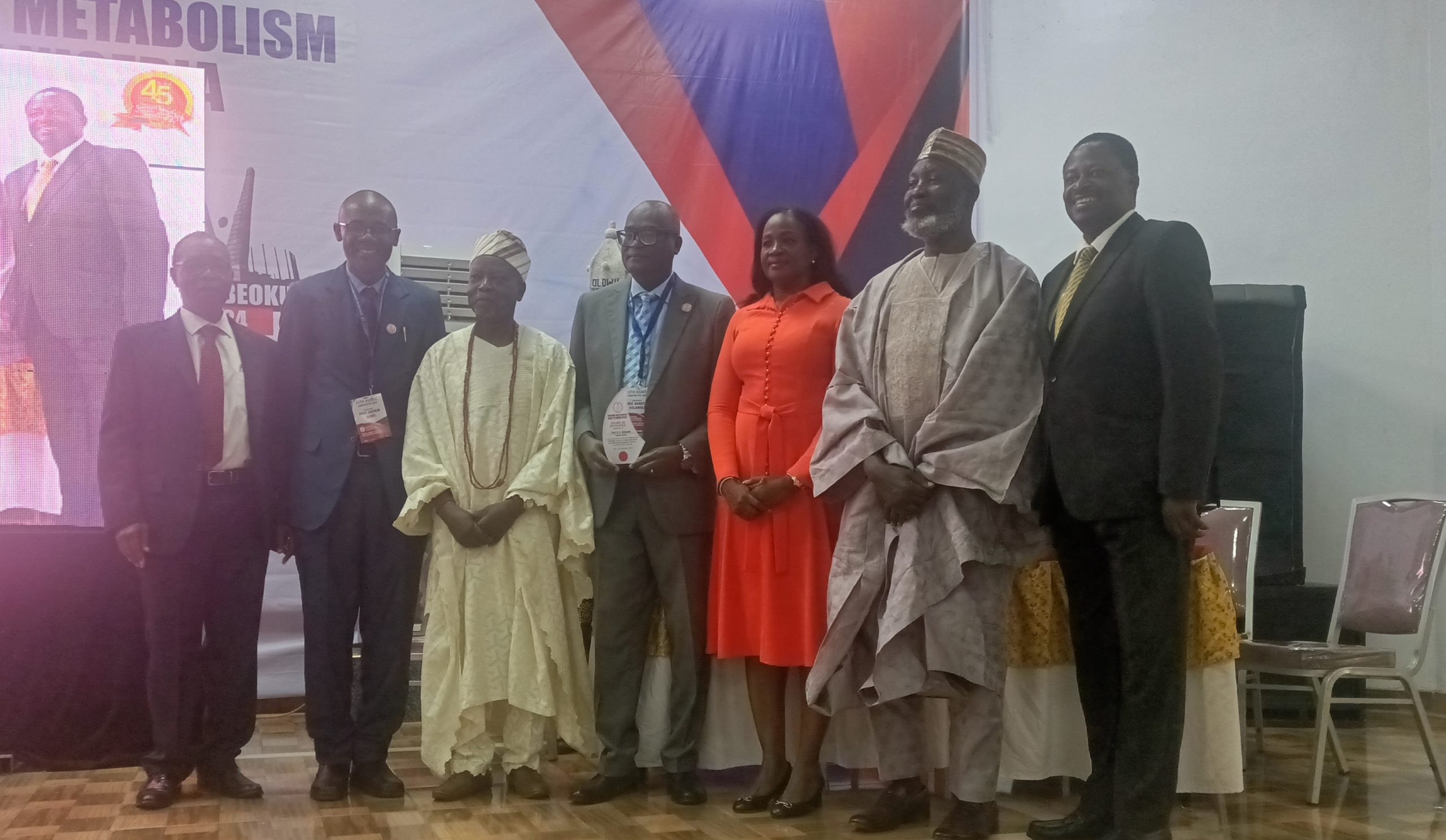
The Endocrine and Metabolism Society of Nigeria (EMSON), the Ogun State government and other stakeholders have advocated for the use of technology to tackle non-communicable diseases like diabetes and other preventable diseases among the people.
The Acting President, EMSON, Prof. Andrew Uloko who said this while speaking at the 45th National Conference of the Association in Abeokuta, the Ogun State capital emphasized the importance of artificial intelligence in healthcare, collaborating with different stakeholders to ensure that all affected individuals and organizations are carried along, particularly people in the rural areas have access to technological equipment.
Prof. Uloko noted that inadequate funding is a significant challenge in the health sector, highlighting the need for awareness about technology’s role in healthcare.
“It is about time we talk about technology, in the way we care for our patients, it is now common in the world, and it is beginning to gain interest in Nigeria now”.
He assured that EMSON will in all ways contribute to health development in Nigeria.
“We hope at the end of this conference dwell heavily on diabetes and technology, and that awareness is created in support of the latest technology devices available”.
“We will also come up with a powerful recommendation in a communique that will be available to healthy policymakers”.
The Acting President emphasised the need to deploy technology and modern innovations to expand access to quality healthcare for the approximately 11 million Nigerians suffering from diabetes.
Prof Uloko also disclosed that the country currently has fewer than 200 endocrinologists to attend to the growing number of patients with diabetes, thyroid issues, obesity, cholesterol disorders, and other endocrine diseases.
He said, “The theme of the conference is informed by the fact that technology is gaining significant traction. We talk about artificial intelligence, robotics, and the use of machine aids in all our spheres of endeavour.
“This is particularly profound in the health sector, so as health experts who deal with endocrine diseases, a major part of non-communicable diseases, we felt we should use these three days to explore how we can deploy these new technologies to enhance the quality of care for our people.”
Uloko expressed hope that by the end of the conference, awareness of readily available technologies that could help care for diabetes and related illnesses would be raised.
Additionally, strong recommendations would be made for policymakers in the country to adopt for the improvement of healthcare delivery.
He further explained that the country currently has fewer than 200 endocrinologists, many of whom are leaving the country in search of better opportunities abroad.
However, Uloko noted that with the use of technology, the challenge of inadequate healthcare professionals—exacerbated by the ‘Japa syndrome’, a term used to describe the migration of professionals in search of better prospects—could be significantly addressed.
He said, “For health experts like endocrinologists, who are very scarce globally and even more so in our country, the numbers are critically low. In our society, we have about 200 or fewer endocrinologists to serve the entire population of Nigeria, and a substantial number of them are still leaving the country. This is a serious concern.
“However, with technology, it is now possible for a patient to transmit data to their doctor in the UK, America, Australia, or anywhere else in the world. Within minutes, the doctor can review the patient’s data, interact with them, and advise on the next steps to improve their health.”
Meanwhile, the Honourable Commissioner for Health Dr. Mrs. Tomi Coker stated that noncommunicable diseases such as diabetes are becoming a burden in Nigeria, and low-middle income countries.
She noted that as the birth of the project 10, Million, Know Your Number, Control Your Number in Ogun which focuses on screening 10, Million Nigerians simultaneously on diabetes and hypertension.
Dr Coker expressed the hope that by the end of the conference, having considered global trends, endocrinologists would recommend technologies that Nigeria could adapt to suit its unique needs, given that over 80 million Nigerians are battling multidimensional poverty.
The Commissioner noted that the theme of the conference was timely, as it aligns with President Bola Tinubu’s government’s desire to digitise healthcare services and reduce the burden of healthcare delivery.
Coker disclosed that they will be partnering with EMSON on the project to deliver it to the nooks and crannies of Nigeria.
She commended EMSON’s effort in integrating technology into treatments of non-communicable diseases.
Also, the keynote speaker at the conference Prof. Babatope Kolawole Tech advances have focused on safer and more accurate glucose measurement and insulin delivery.
He argued that technology-enabled self-management adds that technology spans smartphone apps, modifications of insulin pens, and insulin pumps.
Kolawole stressed that diabetes is a global health issue, with 90% of cases predicted to affect 55 million people by 2045.
He explained how technology has improved glucose measurement and insulin delivery, enabling self-management through smartphone apps, modified insulin pens, and pumps.
“Diabetes is a major global health problem 90% of the issue of Diabetes and predicting that 55 million will have Diabetes in 2045.
In his welcome address, the Chairman of the Local Organising Committee, Dr Olubiyi Adesina, mentioned that around 200 delegates, including endocrinologists, anatomists, pathologists, family physicians, and nutritionists, were attending the conference.