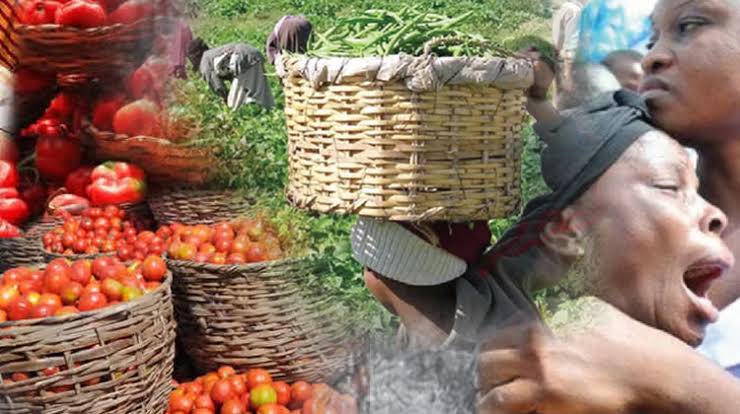
Nigeria’s food insecurity worsens as prices rise non-stop
The number of Nigerians facing food insecurity is rising by the day as prices of commodities continue their relentless rise.
The country has seen its food production decline yearly, causing shortages and price surges that have further strained the finances of millions of poor Nigerians.
Food prices have surged by over 50 percent in the past year, according to experts, who noted that the situation is worsening food insecurity in the country.
“The implication is direct because if purchasing power isn’t going up, it means we are gravitating towards hunger and starvation as most people cannot afford to feed properly,” said Abiodun Olorundero, managing partner at Prasino Farms.
“The country is becoming more food insecure. Crop production has been on the decline for years now and price surge is further compounding the problem,” he added.
The number of Nigerians that are food insecure has increased by 133 percent in three years as poverty deepens, according to the 2023 State of Food Security and Nutrition in the World report. It jumped from 63.8 million people between 2014 and 2016 to 148.7 million people between 2020 to 2022.
Jude Obi, president of the Association of Organic Agriculture Practitioners of Nigeria, highlighted that production levels have declined and will continue to drop on inflationary pressures and increased production costs.
“Production is completely low and will continue to decline,” he said.
AFEX, a commodities exchange, said in its 2023 wet season crop production report that a decrease in production levels has seen the prices of most staple foods consumed in Nigeria, including rice, maize, soya bean, and sorghum, surge, with expectations that they will rise even higher.
BusinessDay’s analysis of the selected food prices data by the National Bureau of Statistics shows that the average prices of food items such as rice (both local and imported), vegetable oil, palm oil, garri (both white and yellow), bread, eggs, and yam rose considerably in 2023.
The average price of 1kg of local rice increased by 59.2 percent to N819.42 in October 2023 from N514.83 in January 2023. The average price of 1kg of imported rice increased by 36.6 percent to N1,016.12 from N744.12.
The average price of vegetable oil (one bottle) stood at N1,489.74 in October, an increase of 25.9 percent from N1,183.67 in January. The average price of palm oil increased by 26.7 percent to N1,322.55 from N1,044.04.
The average price of 1kg of white garri rose 54.2 percent to N520.35 in October from N337.52 in January, while that of yellow garri increased 43.9 percent to N540.87 from N375.87.
The average prices of sliced bread (500g), egg (medium size price of one), and yam tuber (1kg) rose by 39 percent, 19 percent, and 59 percent respectively, in the same period.
Olorundero of Prasino Farms said the rising costs of inputs such as fuel and logistics have significantly impacted production, leading to increased prices of food items.
He said: “I can tell you that the reason why the prices of food have steadily gone up is (even though the cost of production has also gone up) more as a result of the cost of logistics.
“Diesel was about N200/litre. Now it sells for about N1,000 to N1,200/litre. And a truck that is bringing in those food items from the North where they are produced is consuming over 500 litres of diesel. Multiply that by the per-litre price and see what it amounts to.”
Food inflation has risen to record levels, hitting 32.84 percent in November last year from 24.32 percent in January.
The latest data from the Central Bank of Nigeria revealed that 75.4 percent of consumer credit in August were personal loans.
Okafor Tochukwu, a senior lecturer at Baze University, said that with the depreciation of the naira, inflation, and subsidy removal, a lot of households were under pressure as the budget they initially had was unable to meet the economic requirements of their daily lives, forcing them to take personal credits to meet up obligations.