Morocco Quake: Death Tolls Hit 1,300, As Race To Find Survivors Continues
.. Declares Three Days’ Mourning
.. Tinubu condoles with Morocco
By Agency Report
The huge earthquake which hit Morocco overnight killed more than 1,300 people and injured at least another 1,800, many of them critically, the interior ministry said on Saturday.
A total of 1,305 people have now been confirmed dead, while 1,832 people were injured, of whom 1,220 are in critical condition, a ministry statement said.
Three days of national mourning were declared in an announcement from the royal palace.
“Three days of national mourning have been decided, with flags to fly at half-mast on all public buildings,” said a statement published by the official MAP news agency after King Mohammed VI chaired a meeting to discuss the disaster.
The meeting was held after Friday night’s earthquake, the deadliest to hit the North African country in decades, hit southwest of tourist hotspot Marrakesh, killing at least 1,037 people and injuring another 1,204, many of them critically.
After being briefed by officials, the king ordered the immediate establishment of a “commission responsible for the deployment of an emergency rehabilitation and aid programme on rebuilding destroyed housing in disaster areas” and “the care of distressed people, particularly orphans and the vulnerable”.
He also ordered that “accommodation, food and all other basic needs” be made available to those who needed it, as well as the establishment of a special account at the central bank for aid donations.
The 6.8-magnitude quake struck a mountainous area 72 kilometres (45 miles) southwest of tourist hotspot Marrakesh at 11:11 pm (2211 GMT) Friday, the US Geological Survey reported.
Strong tremors were also felt in the coastal cities of Rabat, Casablanca and Essaouira.
Morocco Declares Three Days’ Mourning
Morocco on Saturday declared three days of national mourning after a deadly earthquake overnight killed more than 1,000 people, an announcement from the royal palace said.
“Three days of national mourning have been decided, with flags to fly at half-mast on all public buildings,” said a statement published by the official MAP news agency after King Mohammed VI chaired a meeting to discuss the disaster.
After being briefed by officials, the king ordered the immediate establishment of a “commission responsible for the deployment of an emergency rehabilitation and aid programme on rebuilding destroyed housing in disaster areas” and “the care of distressed people, particularly orphans and the vulnerable”.
He also ordered that “accommodation, food and all other basic needs” be made available to those who needed it, as well as the establishment of a special account at the central bank for aid donations.
‘Biggest in more than 120 years’
The 6.8-magnitude quake struck a mountainous area 72 kilometres (45 miles) southwest of tourist hotspot Marrakesh at 11:11 pm (2211 GMT) Friday, the US Geological Survey reported.
Strong tremors were also felt in the coastal cities of Rabat, Casablanca and Essaouira.
“I was nearly asleep when I heard the doors and the shutters banging,” said Ghannou Najem, a Casablanca resident in her 80s who was visiting Marrakesh when the quake hit.
“I went outside in a panic. I thought I was going to die alone.”
It is the strongest-ever quake to hit the North African kingdom, and one expert described it as the region’s “biggest in more than 120 years”.
“Where destructive earthquakes are rare, buildings are simply not constructed robustly enough… so many collapse, resulting in high casualties,” said Bill McGuire, professor emeritus at Britain’s University College London.
Updated interior ministry figures on Saturday showed the quake killed at least 1,037 people, the vast majority in Al-Haouz, the epicentre, and Taroudant provinces.
Another 1,204 people were injured, including 721 in a critical condition, the ministry said.
The ministry also recorded deaths in Ouarzazate, Chichaoua, Azilal and Youssoufia provinces, as well as in Marrakesh, Agadir and the Casablanca area.
‘Unbearable’ screams
Faisal Badour, an engineer, said he felt the quake three times in his building in Marrakesh.
“There are families who are still sleeping outside because we were so scared of the force of this earthquake,” he said. “The screaming and crying was unbearable.”
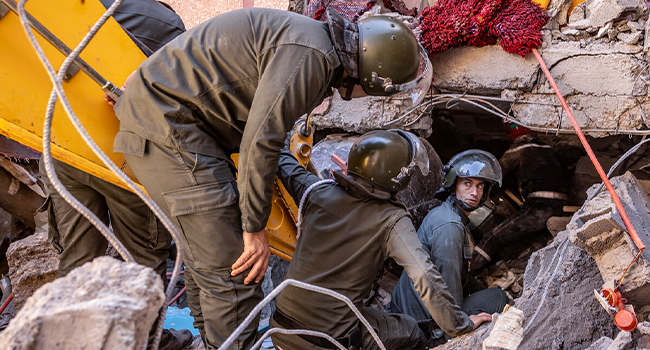
In Moulay Brahim village, in the mountains of Al-Haouz province near the quake’s epicentre, rescuers were searching for survivors in the rubble of collapsed houses, AFP correspondents reported.
On a nearby hill, residents began digging graves for the victims, the correspondents said.
Frenchman Michael Bizet, 43, who owns three traditional riad houses in Marrakesh’s old town, told AFP that he was in bed when the quake struck.
“I thought my bed was going to fly away. I went out into the street half-naked and immediately went to see my riads. It was total chaos, a real catastrophe, madness,” he said.
Footage on social media showed part of a minaret collapsed on Jemaa el-Fna square in the historic city.
An AFP correspondent saw hundreds of people flocking to the square to spend the night for fear of aftershocks, some with blankets while others slept on the ground.
Mimi Theobold, 25, a tourist from England, said she was with friends on a restaurant terrace when the tables began shaking and plates went flying.
Houda Outassaf, a local resident, said she was “still in shock” after feeling the earth shake beneath her feet — and losing relatives.
“I have at least 10 members of my family who died… I can hardly believe it, as I was with them no more than two days ago,” she said.
The interior ministry said authorities have “mobilised all the necessary resources to intervene and help the affected areas”.
The regional blood transfusion centre in Marrakesh called on residents to donate blood for those injured.
The army has set up a field hospital in Moulay Brahim and deployed “significant human and logistical resources” to support search and rescue efforts in Al-Haouz, state news agency MAP said.
Significant damage likely
“We heard screams at the time of the tremor,” a resident of Essaouira, 200 kilometres (125 miles) west of Marrakesh, told AFP. “Pieces of facades have fallen.”
The USGS PAGER system, which provides preliminary assessments on the impact of earthquakes, issued a “red alert” for economic losses, saying extensive damage is probable.
Foreign leaders expressed their condolences and many offered assistance, including Israel with which Morocco normalised relations in 2020.
US President Joe Biden said in a statement he was “deeply saddened by the loss of life and devastation”.
Chinese leader Xi Jinping expressed “deep grief for the victims” and hope that “the Moroccan government and people will be able to overcome the impact of this disaster”, according to Beijing’s state media.
Pope Francis expressed “his profound solidarity with those who are touched in the flesh and heart by this tragedy”.
The earthquake was also felt in neighbouring Algeria, where the Algerian Civil Defence said it had not caused any damage or casualties.
In 2004, at least 628 people were killed and 926 injured when a quake hit Al Hoceima in northeastern Morocco, and in 1960 a magnitude 6.7 quake in Agadir killed more than 12,000.
The 7.3-magnitude El Asnam earthquake in Algeria killed 2,500 people and left at least 300,000 homeless in 1980.
President Bola Tinubu, in a statement by Ajuri Ngelale, his media adviser, extended his condolences to King Mohammed VI of Morocco on the tragedy.
Tinubu assured the government and people of Morocco that the heartfelt prayers and thoughts of Nigerians are with them during this difficult moment.
The president commiserated with all families affected by the incident, while wishing a full and swift recovery to those who were injured.
“In the face of this adversity, Nigeria will continue to stand in solidarity with Morocco as they recover, rebuild and come out stronger than ever from this unfortunate event,” the statement reads.
AFP